

Have you ever wondered why some mines run with strict hierarchies, while others depend heavily on teamwork, communication, and trust?
Or why time-study and motion-study are used to improve productivity, but psychology and motivation techniques are used to improve safety?
The answer lies in the Evolution of Management.
Management did not emerge instantly. It evolved as industries expanded, machines replaced hand-tools, and workplace challenges became more complex. To solve these changing problems, different theories emerged — each focusing on new ways to make work more effective.
In this chapter, we will understand the four major pillars of management evolution:
- Classical Management Theory
- Behavioral (Human Relations) Theory
- Contingency Theory
- Modern Management Theory
1. Classical Management Theory
(The Foundation of Structure, Rules & Efficiency)
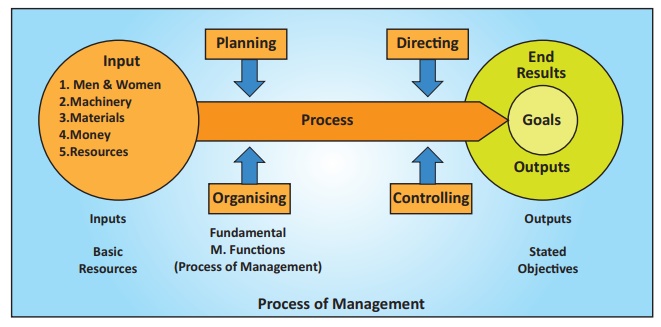
The Classical Theory dominated from the late 1800s to early 1900s. It assumed that workers are rational and motivated by money, and work becomes efficient when it is properly designed, supervised, and controlled.
Classical Theory includes:
✔ Scientific Management — F.W. Taylor
✔ Administrative/Functional Management — Henri Fayol (Chapter 1)
✔ Bureaucratic Management — Max Weber
A. Scientific Management (F.W. Taylor)
“Father of Scientific Management”
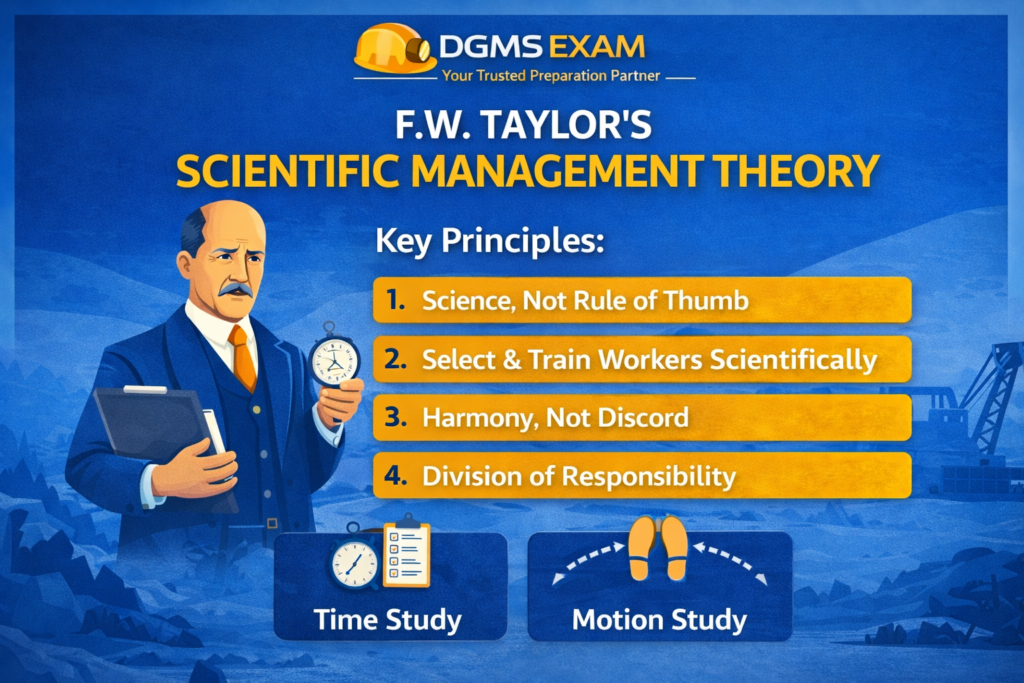
Before Taylor, workers followed the Rule of Thumb — guesswork based on personal experience.
This led to low productivity, inconsistent output, and unsafe practices.
Taylor introduced science into work.
Core Principles of Scientific Management
- Science, Not Rule of Thumb
– Determine the best method scientifically (time study, motion study). - Scientific Selection & Training
– Select the right worker, train them, and standardize their work. - Harmony, Not Discord
– Reduce conflict through cooperation between workers & management. - Division of Responsibility
– Management plans the work
– Workers execute the work
Key Tools & Techniques (Important for DGMS Exams)
- Time Study
Measures how long a task should take. - Motion Study
Eliminates unnecessary body movements to reduce fatigue. - Standardization of Tools, Methods & Conditions
- Functional Foremanship
✔ Multiple specialized supervisors guide one worker
❗ This violates Fayol’s “Unity of Command” principle (exam trick).
B. Bureaucratic Management (Max Weber)
Focus: A structured, rule-based, predictable organization
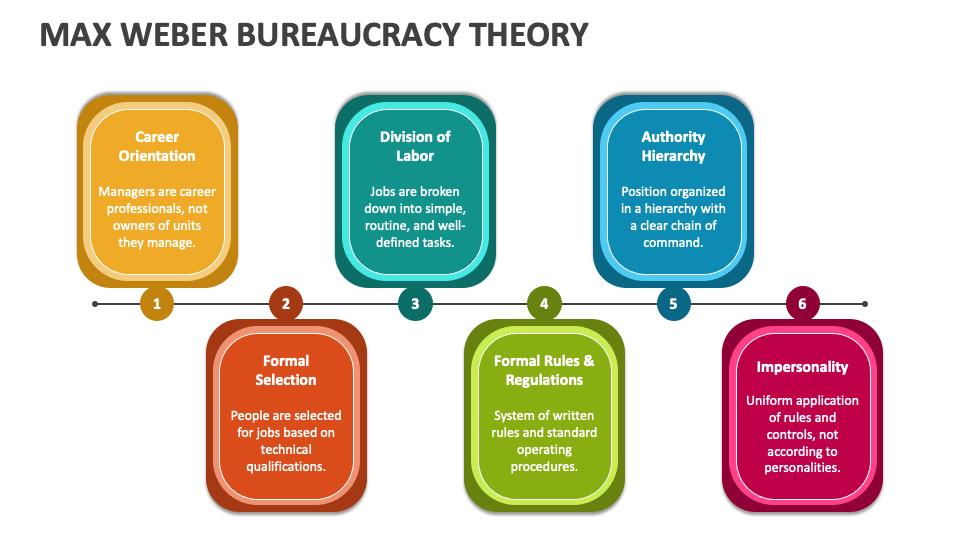
Weber noticed that early organizations ran on favoritism and personal decisions.
He introduced bureaucracy to guarantee fairness, discipline, and legal compliance.
Key Features of Bureaucracy
- Formal Rules & Procedures
(e.g., Mines Act, SOPs, Standing Orders) - Rational–Legal Authority
Power comes from the position, not the personality. - Impersonal Relationships
Decisions based on rules → ensures fairness. - Clear Hierarchy
Example:
Manager → Overman → Sirdar → Workers - Written Records
Essential for safety audits, legal evidence, DGMS inspections.
Criticism
- Promotes rigidity
- Leads to slow decision-making
- Less innovation
Still, in mining, bureaucracy is highly essential for safety & legal compliance.
2. Behavioral (Human Relations) Theory
(The Shift from Machines to People)
Classical theory failed because it treated workers as machines.
It ignored emotions, motivation, social needs, and group influence.
Behavioral Theory argues:
“A satisfied worker is a productive worker.”
Elton Mayo & The Hawthorne Experiments (1924–1932)
Father of Human Relations Movement
These experiments changed management forever.
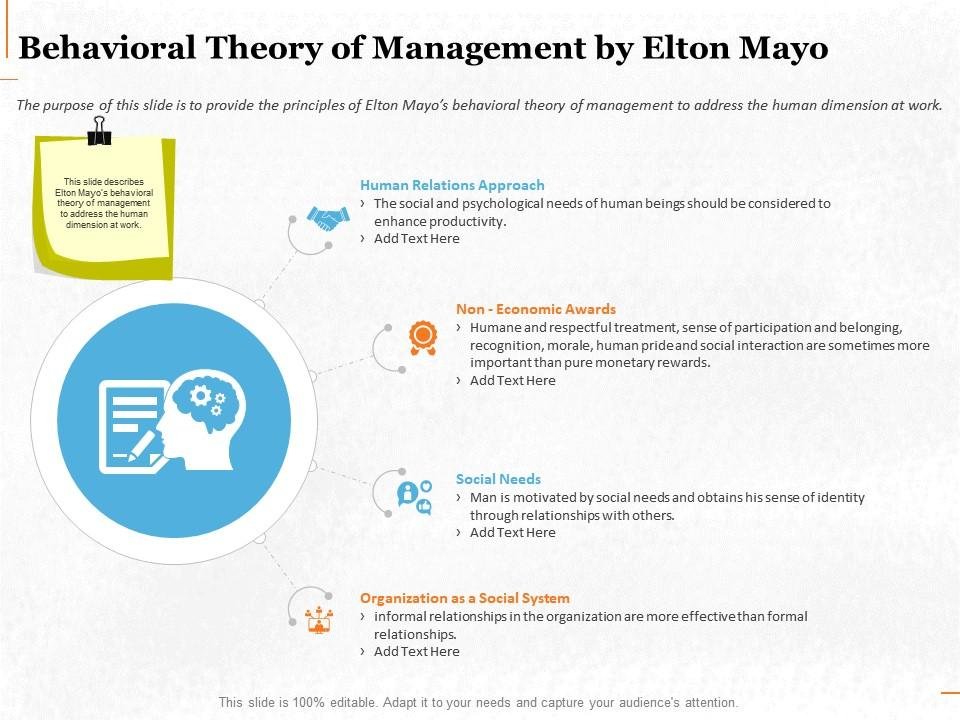
The Hawthorne Experiments & Their Findings
1. Illumination Experiment
Different lighting levels → productivity increased even when lights were dimmed.
Conclusion: Psychological factors matter more than physical conditions.
2. Relay Assembly Test Room
Workers received attention & recognition.
Conclusion: Supervisor support and appreciation improve performance.
3. Bank Wiring Room Study
Workers restricted output to match group norms.
Conclusion: Informal groups strongly influence behavior.
Maslow’s Hierarchy of Needs
Motivation depends on satisfying human needs in order:
- Physiological (wages, food)
- Safety (job security, safe workplace)
- Social (belongingness)
- Esteem (recognition)
- Self-Actualization (growth)
In mines, Safety and Physiological needs are the highest priority.
3. Contingency Management Theory
(The “It Depends” Approach)
This theory argues that:
There is no single best way to manage.
Management depends on the situation.
Examples in Mining
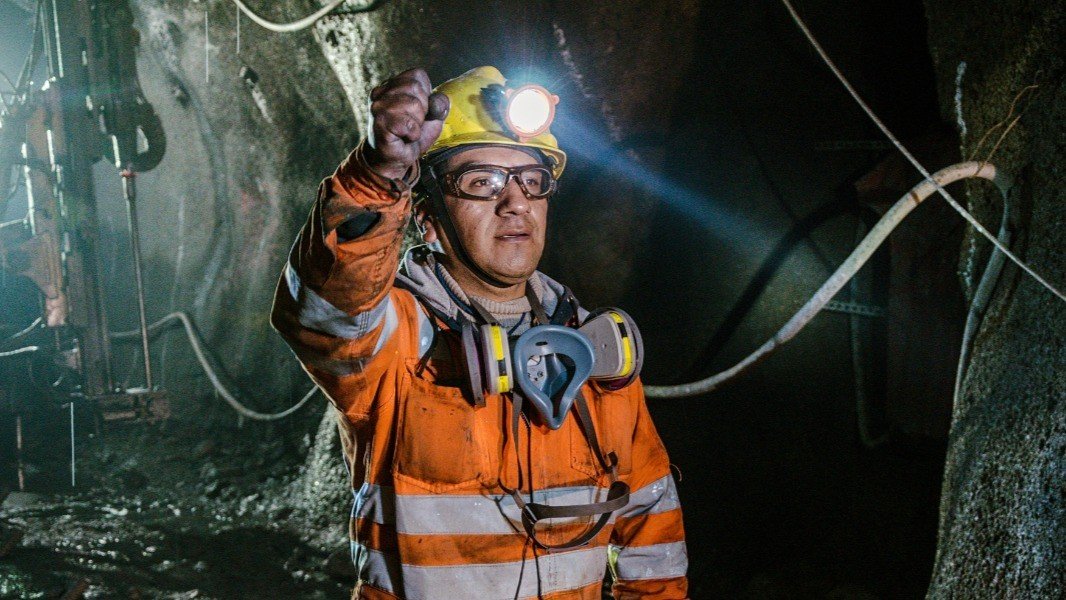
- During a mine fire → Autocratic leadership
Quick decisions are essential. - During daily operations → Participative leadership
Input from workers improves safety and efficiency.
Contingency Factors
- Technology
- Nature of work
- Workforce skills
- Environmental uncertainty
- Organizational size
- Safety risk level
4. Modern Management Theory
(The Integrated, Technology-Driven View)
Modern Theory brings together:
✔ Efficiency (Classical)
✔ Human needs (Behavioral)
✔ Situational flexibility (Contingency)
✔ Technology, data & systems
Let’s look at its key components.
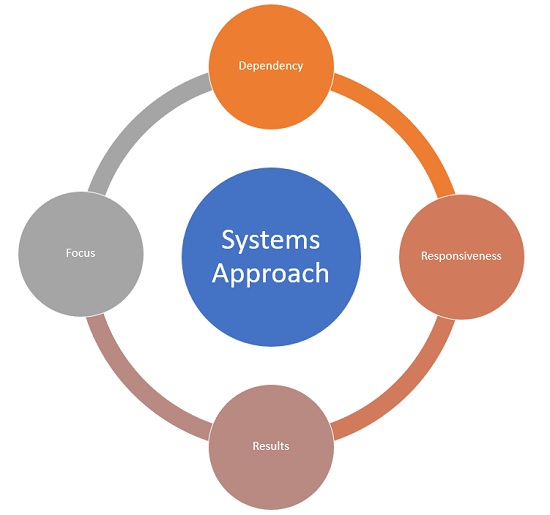
A. Systems Approach
Organization = A system of interconnected parts.
Input → Process → Output
Example in mining:
- Input: Workers, machinery, explosives
- Process: Drilling, blasting, loading
- Output: Coal production & safety performance
A failure in one part affects the whole system (e.g., ventilation issue stops production).
B. Total Quality Management (TQM)
Focus: Continuous improvement + Customer satisfaction
In mining, “customer” also includes:
✔ DGMS
✔ Local community
✔ Workers (internal customers)
Principle: Quality is everyone’s responsibility.
C. Modern Productivity Techniques (Exam Favorites)
1. Just-In-Time (JIT)
Produce or supply materials only when needed.
✔ Reduces inventory cost
✔ Avoids stockpiling explosives unnecessarily
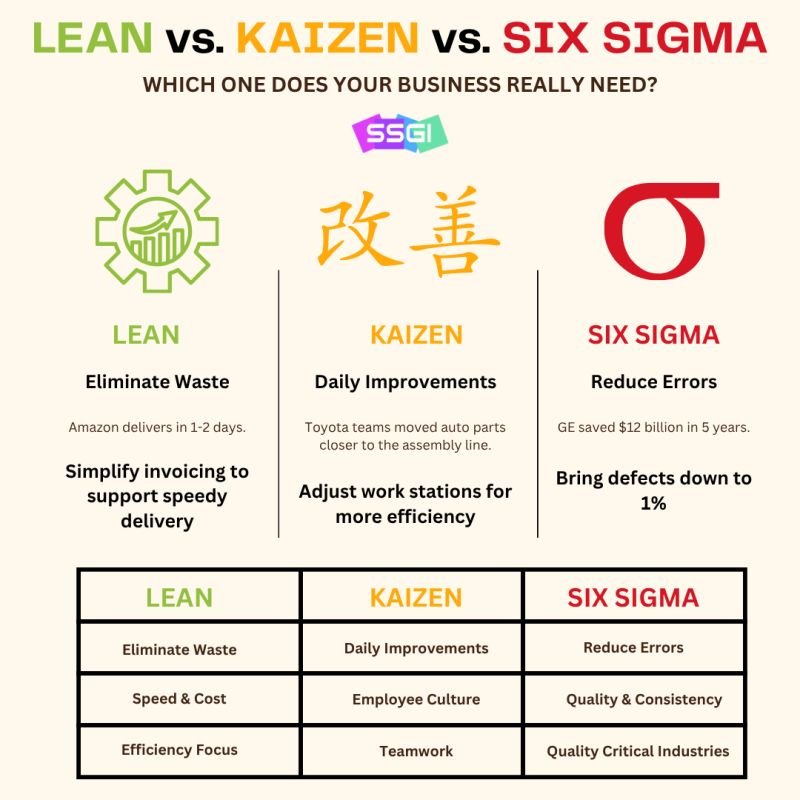
2. Lean Management
Eliminate waste such as:
- Idle machinery
- Excess movement
- Delays
- Rework
3. Kaizen
Continuous small improvements by every employee.
4. Six Sigma
Statistical tool to reduce defects → Near zero error.
📌 DGMS Quick Revision Table (Cheat Sheet)
| Theory | Key Person | Focus | Keyword |
|---|---|---|---|
| Scientific | F.W. Taylor | Job efficiency | Science, not rule of thumb |
| Administrative | Henri Fayol | Functions of management | Planning–Organizing–Commanding–Coordinating–Controlling |
| Bureaucratic | Max Weber | Rules & structure | Rational-Legal Authority |
| Behavioral | Elton Mayo | People & relationships | Hawthorne Experiments |
| Contingency | — | Situational approach | It depends |
| Modern | — | Integration + technology | Systems, Quality, Lean |
📘 MCQs – Evolution of Management (Chapter 2)
(With Answers & Explanations)
1. Which management theory focuses on rules, hierarchy, and formal structure?
A. Behavioral Theory
B. Classical Theory
C. Contingency Theory
D. Modern Theory
Correct Answer: B
Explanation: Classical Theory emphasizes structure, rules, and efficiency.
2. Who is known as the Father of Scientific Management?
A. Max Weber
B. Henri Fayol
C. F.W. Taylor
D. Elton Mayo
Correct Answer: C
Explanation: F.W. Taylor introduced Scientific Management principles.
3. Scientific Management replaced which old method of working?
A. Division of Labor
B. Rule of Thumb
C. Time Study
D. Organizational Hierarchy
Correct Answer: B
Explanation: Taylor replaced guesswork (Rule of Thumb) with scientific study.
4. Time Study is used to measure:
A. Worker motivation
B. Best lighting conditions
C. Time required to complete a task
D. Employee satisfaction
Correct Answer: C
Explanation: Time Study identifies the standard time for performing tasks.
5. Motion Study aims to:
A. Reduce unnecessary movements
B. Increase rest time
C. Improve team bonding
D. Increase wages
Correct Answer: A
Explanation: Motion Study removes wasteful movements to improve efficiency.
6. Functional Foremanship violates which principle of Fayol?
A. Unity of Direction
B. Order
C. Equity
D. Unity of Command
Correct Answer: D
Explanation: Multiple supervisors violate the “one boss, one command” rule.
7. Max Weber is associated with which type of management?
A. Bureaucratic Management
B. Scientific Management
C. Human Relations Management
D. Contingency Management
Correct Answer: A
Explanation: Weber introduced the concept of bureaucracy in organizations.
8. A key feature of Bureaucracy is:
A. Personal decisions
B. Random authority
C. Rational-Legal Authority
D. Emotional leadership
Correct Answer: C
Explanation: In bureaucracy, authority is based on rules and position, not personality.
9. The Hawthorne Experiments were conducted by:
A. Max Weber
B. Elton Mayo
C. Abraham Maslow
D. Peter Drucker
Correct Answer: B
Explanation: Elton Mayo is known for the Human Relations Movement.
10. The main conclusion of the Hawthorne Studies was:
A. Money is the only motivator
B. Physical conditions matter most
C. Psychological and social factors influence productivity
D. Strict supervision increases output
Correct Answer: C
Explanation: Worker morale, recognition, and group behavior affect performance.
11. Maslow’s theory is related to:
A. Hierarchy of Needs
B. Scientific principles
C. Systems approach
D. Bureaucracy
Correct Answer: A
Explanation: Maslow proposed a five-level hierarchy of human needs.
12. Contingency Theory states:
A. One best method exists
B. It depends on the situation
C. Workers act like machines
D. Rules must always be followed
Correct Answer: B
Explanation: Contingency = situational approach; managers adapt based on conditions.
13. Autocratic leadership is best suited for:
A. Team meetings
B. Mine fire emergencies
C. Training programs
D. Routine work
Correct Answer: B
Explanation: Emergency situations require fast, top-down decision-making.
14. In the Systems Approach, organization is viewed as:
A. A group of unrelated parts
B. A collection of individuals
C. An interconnected system of departments
D. A rigid structure
Correct Answer: C
Explanation: The Systems Approach sees the organization as interconnected units working together.
15. Kaizen refers to:
A. Large improvements
B. Strict supervision
C. Continuous small improvements
D. Employee punishment
Correct Answer: C
Explanation: Kaizen means continuous, incremental improvement involving all employees.
Final Thought
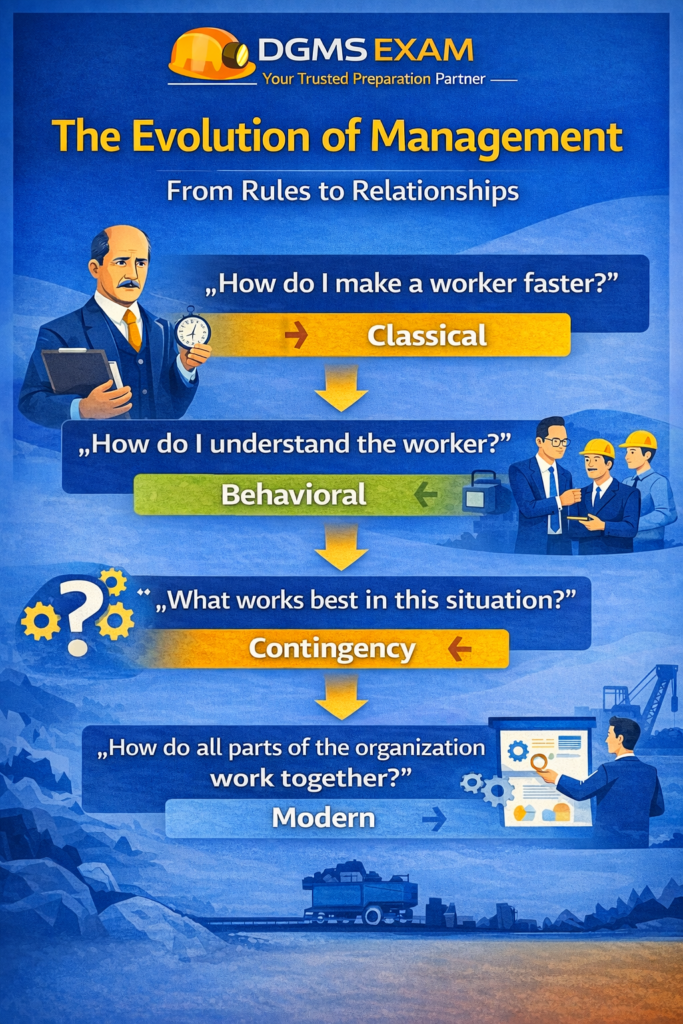
Management evolved as industries, machines, and human needs changed.
It moved from rigid rules → understanding people → situational decisions → system-wide integration.
This evolution explains why today’s management requires:
✔ Efficiency
✔ Motivation
✔ Flexibility
✔ Technology
✔ Teamwork
✔ Continuous improvement
Understanding this evolution is crucial for DGMS exam conceptual questions, real-world mining management, and improving safety culture.
📚 Summary of Chapter 2: The Evolution of Management
Management has evolved over more than a century to respond to the changing needs of industries, technology, workforce behavior, and organizational complexity. This chapter explains how management thinking moved step-by-step from rules and structure to understanding people, adapting to situations, and finally integrating systems and technology.